
Most small retail businesses are losing customers before they ever walk through the door — or open the browser tab. The problem is rarely the product. It’s the first impression, and for most shoppers in 2026, that impression happens online.
An ecommerce website design that looks outdated, loads slowly, or feels clunky doesn’t just inconvenience people. It signals that your business isn’t serious. That might sound harsh, but it’s what a customer feels in the three seconds before they close the tab and check out your competitor.
This post looks at what a well-built ecommerce site actually delivers for a small retail business — using a real example we built here at Kursor Creative to show what’s possible.
The gap between a good product and a sale
You can stock the best gear on the South Coast and still lose the sale to a competitor with a worse product but a sharper website. That’s the reality of modern retail.
Shoppers research before they buy. They Google, they browse, they check Instagram, and they land on your site expecting it to look as good as the product you’re selling. If your site was built years ago on a cheap template, hasn’t been updated since, or doesn’t work properly on a phone, the customer doesn’t give you the benefit of the doubt. They just leave.
What a dated site communicates — even if unintentionally — is that your business isn’t keeping pace. That doubt costs you sales every single day, quietly, without you ever knowing who left.
What good ecommerce design looks like in practice
Brand that does the selling before the product page loads
The best ecommerce sites don’t lead with product grids. They lead with feeling.
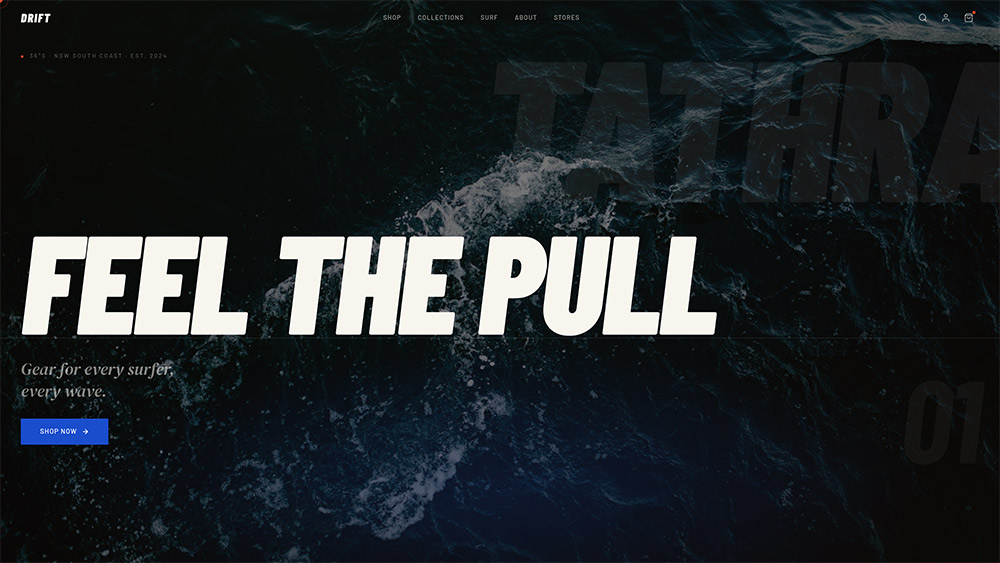
When we built Drift — a concept surf and apparel store for the NSW South Coast — the hero section doesn’t list features or discount codes. It says Feel the pull. Three words, a full-screen ocean shot, and a single “Shop Now” button. That’s it. And it works, because it puts the customer inside the world of the brand before they’ve seen a single product.
This approach works for any lifestyle retail business — surf, outdoor gear, fashion, homewares, sporting goods. Your first job is to make the customer feel something. The product grid comes second.
Product discovery that doesn’t frustrate
Once a customer is interested, friction is the enemy. Every extra click, every confusing menu, every product page that loads slowly is a chance for them to leave.
Good ecommerce site architecture means: a clean navigation that makes category sense, a search bar that actually works, quick-add to cart from collection pages, and product images that load fast and look sharp on mobile.
These aren’t fancy extras. They’re table stakes for any retail site that wants to convert browsers into buyers.
The features small retailers actually need — and rarely get
A blog that builds authority, not just content
Content is one of the highest-return investments a retail business can make in its website. Not generic filler content, but genuinely useful editorial that your customers actually want to read.
The Drift site includes a blog section called Field Notes — gear guides, surf spot breakdowns, wetsuit comparisons, how-to articles. It keeps customers coming back between purchases, builds search engine authority, and positions the brand as an expert, not just a shop.
A well-run blog does three things at once: it drives organic traffic from Google, it builds trust with readers who become buyers, and it gives you content to share across social media. Most retail businesses don’t have one, which means the ones that do have a real edge.
Social proof baked into the shopping experience
Customers trust other customers more than they trust any brand. Product star ratings, review counts, and user-generated content from Instagram aren’t decorative — they’re conversion tools.
The Drift build integrates an Instagram feed directly into the homepage, showing real imagery from the water alongside the products. It bridges the gap between social discovery and purchase intent. A customer who found you on Instagram and then lands on a site that mirrors that same visual language is far more likely to buy.
Mobile-first, not mobile-afterthought
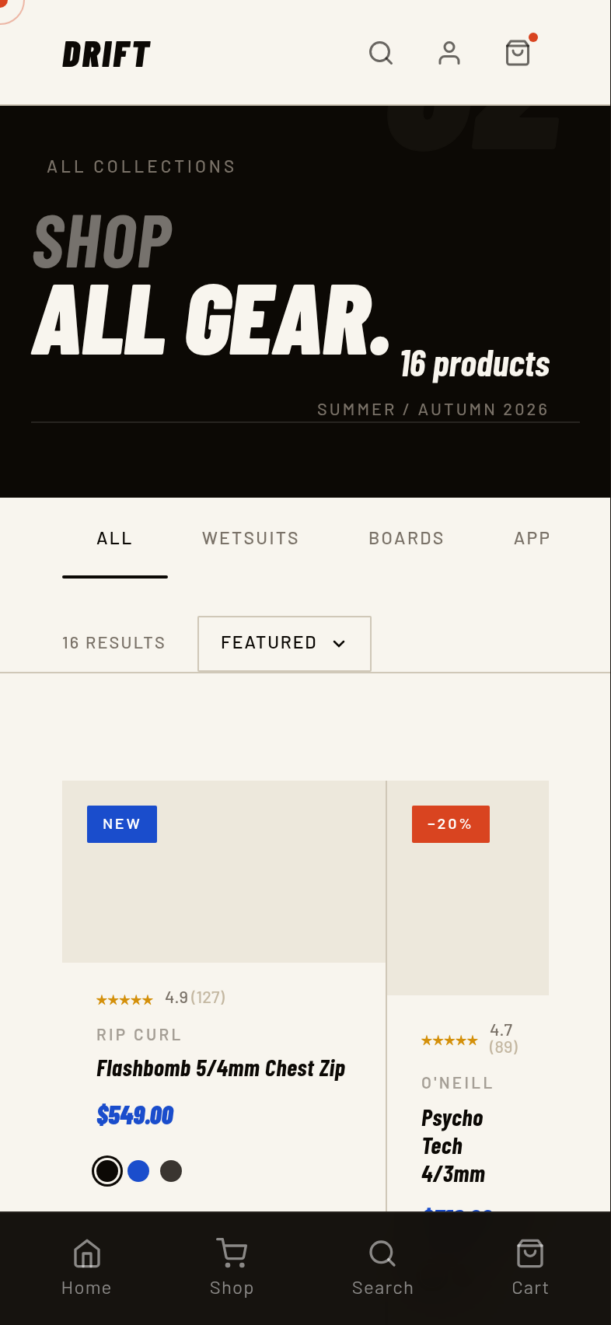
More than 70% of ecommerce traffic now comes from mobile devices. If your site was designed for desktop and squeezed into a phone screen, customers feel it — slow loads, buttons that are hard to tap, product images that don’t display correctly.
A properly built mobile-first ecommerce site isn’t a scaled-down version of the desktop. It’s designed for thumb navigation from the ground up. Fast, clean, and intuitive on the device most of your customers are actually using.
Why “we’ll update it later” costs you more than a rebuild
Every month a slow, dated, or broken site stays live, it’s costing you. Not in an abstract future-cost way — in real, measurable ways right now.
Google uses site speed and mobile performance as ranking signals. A poorly performing site ranks lower, which means fewer people find you organically. That compounds over time: the longer you sit on a bad site, the further back in search results you slide, and the harder it is to recover.
Beyond search, there’s the direct conversion impact. A modern ecommerce site typically converts between 2-4% of visitors. An outdated one often converts below 1%. For a business doing $500,000 in annual online revenue, the difference between a 1% and 3% conversion rate isn’t incremental — it’s transformational.
The cost of a well-built site is a one-time investment. The cost of keeping a bad one is ongoing, invisible, and impossible to recover.
What to look for in a web design partner
Not every agency that builds websites builds them well. Here’s what actually matters when you’re choosing who to work with.
Custom design over templates. A template site gets you live quickly and cheaply, but it won’t be built around your brand, your customers, or your products. You end up fitting your business into someone else’s box. A custom-built site is designed to fit you.
Ongoing support, not a hand-off. A website isn’t a finished product — it needs updates, performance monitoring, and refinement as your business grows. Ask any potential agency what happens after launch. If the answer is vague, keep looking.
SEO built in from the start. A beautiful site that nobody can find is just an expensive business card. Good web design and good SEO are not separate disciplines. The structure, speed, and content strategy of your site should be planned together, not bolted on afterwards.
A track record with retail. Retail ecommerce has specific requirements — product management, inventory, checkout flows, returns, customer accounts. Ask to see retail work. Look at real examples, not mockups.
Ready to see what your business could look like online?
The Drift site is a working example of what we build at Kursor Creative — a full ecommerce experience designed for a retail business with an identity, a community, and products worth showing off properly.
If your current site isn’t doing justice to your business, let’s talk. We work with small retailers across Australia to design and build websites that actually drive sales. No lock-in, no jargon — just a straightforward conversation about what you need and what’s possible.
Get in touch with Kursor Creative to book a free discovery call.